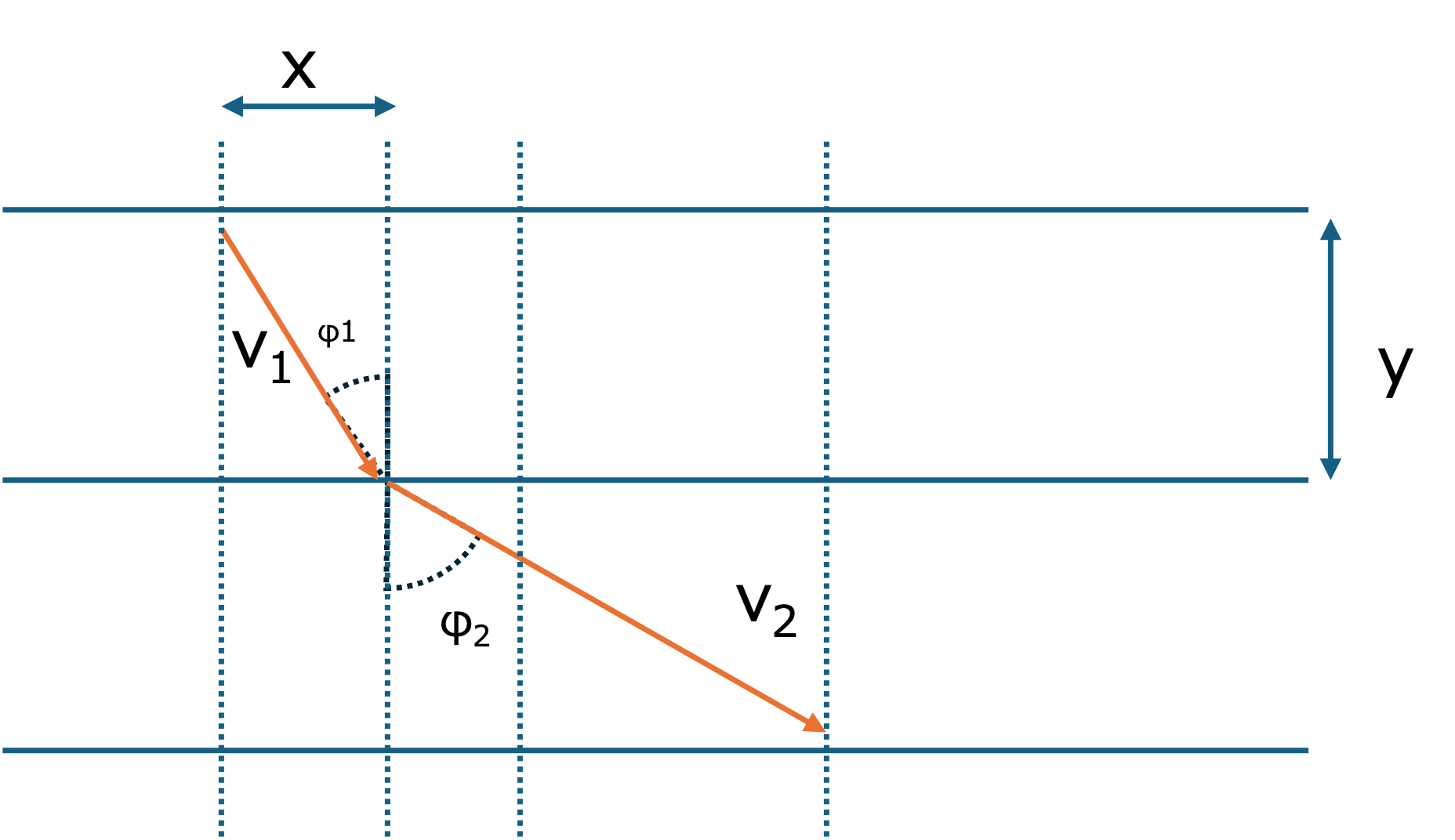
最速降下曲線-02
・曲線の導出
上記の式と速度とyとの関係式から,
$$
{ \Large \displaystyle
\begin{equation}
\begin{split}
\frac{sin \ \phi}{v} &= C\\
v &= \sqrt{2gy}\\
\frac{sin \ \phi}{\sqrt{2gy}} &= C\\
sin^2 \ \phi &= 2 \ g \ y \ C^2 \rightarrow C^2 y\\
tan \ \phi &= \frac{dx}{dy} \\
tan^2 \ \phi &= \frac{sin^2 \ \phi}{cos^2 \ \phi} = \frac{sin^2 \ \phi}{1 - sin^2 \ \phi} \\
\end{split}
\end{equation}
}
$$
となります.ここで,定数Cを,
$$
{ \Large \displaystyle
\begin{equation}
\begin{split}
C^2 \equiv \frac{1}{2a} \\
\end{split}
\end{equation}
}
$$
とおけば,
$$
{ \Large \displaystyle
\begin{equation}
\begin{split}
\left( \frac{dx}{dy} \right)^2&= \frac{C^2 y }{1 - C^2 y} \\
\frac{dx}{dy} &= \sqrt{ \frac{y/(2a)}{1- y/(2a)}} =\sqrt{ \frac{y}{2a - y}}
\end{split}
\end{equation}
}
$$
となる,x,yを求めればいいことになります..xは積分すればいいので,
$$
{ \Large \displaystyle
\begin{equation}
\begin{split}
x &= \int \sqrt{ \frac{y}{2a - y}} \ dy
\end{split}
\end{equation}
}
$$
を計算すればよいことになります.
$$
{ \Large \displaystyle
\begin{equation}
\begin{split}
u &\equiv \sqrt{ \frac{y}{2a - y}} \\
\end{split}
\end{equation}
}
$$
とすると,
$$
{ \Large \displaystyle
\begin{equation}
\begin{split}
u^2 &= \frac{y}{2a - y} \\
2a u^2 -u^2 y &= y \\
y &= \frac{2a u^2}{1 + u^2} \\
\frac{dy}{du} &= \frac{4a u}{1 + u^2} - \frac{4a u^3}{(1 + u^2)^2} \\
&= \frac{4au + 4au^3 -4a u^3}{(1 + u^2)^2} \\
&= \frac{4au }{(1 + u^2)^2} \\
\frac{dx}{dy} &= u = \sqrt{ \frac{y}{2a - y}} \\
dx &= u \ dy = \frac{4au^2 }{(1 + u^2)^2} \ du \\
x &= 4a \int \frac{u^2 }{(1 + u^2)^2} \ du \\
&= 4a \left( \frac{1}{2} tan^{-1} \ u - \frac{u}{2(1 + u^2)} \right) \\
&= 2a \left( tan^{-1} \ u - \frac{u}{(1 + u^2)} \right) \\
y &= \frac{2a u^2}{1 + u^2} \\
\end{split}
\end{equation}
}
$$
ここで,
$$
{ \Large \displaystyle
\begin{equation}
\begin{split}
u &\equiv tan \ \frac{\theta}{2} \rightarrow \theta = 2 \ tan^{-1} \ u \\
\frac{2u}{1 + u^2} &= \frac{2 \ tan ( \theta/2)}{1 + tan^2 ( \theta/2)} =
\frac{2 \ \frac{sin ( \theta/2)}{ cos (\theta/2)}}{\frac{cos^2 ( \theta/2)}{( cos^2\theta/2)} + \frac{sin^2 ( \theta/2)}{ cos^2 (\theta/2)}} \\
&= 2 \ \frac{sin ( \theta/2)}{ cos (\theta/2)} \ cos^2 (\theta/2) = 2 sin ( \theta/2) \cdot cos (\theta/2) \\
sin \ \theta \cdot cos \ \theta &= \frac{ e^{i \theta} + e^{-i \theta}}{2} \cdot \frac{ e^{i \theta} - e^{-i \theta}}{2i} \\
&= \frac{ e^{2i \theta} - e^{-2i \theta}}{4i} = \frac{1}{2} sin ( 2 \theta) \\
\frac{2u}{1 + u^2} &=2 sin ( \theta/2) \cdot cos (\theta/2) = sin \ \theta \\
2 \ tan^{-1} \ u &= \theta \\
\end{split}
\end{equation}
}
$$
また,
$$
{ \Large \displaystyle
\begin{equation}
\begin{split}
u &\equiv tan \ \frac{\theta}{2} \rightarrow \theta = 2 \ tan^{-1} \ u \\
\frac{u^2}{1 + u^2} &= \frac{ \ tan^2 ( \theta/2)}{1 + tan^2 ( \theta/2)} =
\frac{ \ \frac{sin^2 ( \theta/2)}{ cos^2 (\theta/2)}}{\frac{cos^2 ( \theta/2)}{( cos^2\theta/2)} + \frac{sin^2 ( \theta/2)}{ cos^2 (\theta/2)}} \\
&= \frac{sin^2 ( \theta/2)}{ cos^2 (\theta/2)} \ cos^2 (\theta/2) = sin^2 ( \theta/2) \\
sin^2 \ \theta &= \left( \frac{ e^{i \theta} - e^{-i \theta}}{2i} \right)^2\\
&= - \frac{ e^{2i \theta} - 2 + e^{-2i \theta}}{4} \\
&= \frac{ 1}{2} - \frac{ e^{2i \theta} + e^{-2i \theta}}{4} \\
&= \frac{ 1}{2} - \frac{ cos (2 \theta)}{2} \\
2 sin^2 \ \frac{\theta}{2} &= 1 - cos \ \theta
\end{split}
\end{equation}
}
$$
となるので,
$$
{ \Large \displaystyle
\begin{equation}
\begin{split}
x &= 2a \left( tan^{-1} \ u - \frac{u}{(1 + u^2)} \right) \\
&= a ( \theta - sin \ \theta)\\
y &= \frac{2a u^2}{1 + u^2} \\
&= a (1 - cos \ \theta)
\end{split}
\end{equation}
}
$$
x,yは,
$$
{ \Large \displaystyle
\begin{equation}
\begin{split}
x &= a ( \theta - sin \ \theta)\\
y &= a (1 - cos \ \theta) \\
\end{split}
\end{equation}
}
$$
となり,この曲線は,サイクロイド,と呼びます.
・時間との関係
では,この,θ,はどのような時間変化をするのでしょう?
必要な式をまとめると,
$$
{ \Large \displaystyle
\begin{equation}
\begin{split}
x &= a ( \theta - sin \ \theta)\\
y &= a (1 - cos \ \theta) \\
v &= \sqrt{2gy}\\
&= \sqrt{2ga (1 - cos \ \theta) }\\
&\left( 2 sin^2 \ \frac{\theta}{2} = 1 - cos \ \theta \right) \\
&= \sqrt{2ga } \ sin \ \frac{\theta}{2}\\
\end{split}
\end{equation}
}
$$
曲線上の微小距離 dsは,
$$
{ \Large \displaystyle
\begin{equation}
\begin{split}
x &= a ( \theta - sin \ \theta)\\
dx &= a ( 1 - cos \ \theta)\\
y &= a (1 - cos \ \theta) \\
dy &= a sin \ \theta \\
ds^2 &= dx^2 + dy^2 = a^2 [( 1 - cos \ \theta)^2 + sin^2 \ \theta] \ d \ \theta^2\\
&= a^2[1 - 2 \ cos \ \theta + cos^2 \ \theta + sin^2 \ \theta] \ d \ \theta^2\\
&= 2a^2 [1 - cos \ \theta] \ d \ \theta^2\\
ds &= a \sqrt{2(1 - cos \ \theta)} \ d \ \theta\\
&= a \sqrt{2 \cdot 2 sin^2 \ \frac{\theta}{2}} \ d \ \theta\\
&= 2a \ sin \ \frac{\theta}{2} \ d \ \theta\\
\end{split}
\end{equation}
}
$$
微小時間と微小速度との関係は,$ dt = ds/v $,となるので,
$$
{ \Large \displaystyle
\begin{equation}
\begin{split}
dt &= \frac{2a \ sin ( \theta/2)}{\sqrt{2ga } \ sin \ ( \theta/2)} \ d \ \theta \\
&= \sqrt{\frac{a}{g}}\ d \ \theta \\
t &= \sqrt{\frac{a}{g}}\ \theta \\
\theta &= \sqrt{\frac{g}{a}} \ t = \omega t \left( \omega \equiv \sqrt{\frac{g}{a}} \right) \\
x &= a ( \omega t - sin \ \omega t)\\
y &= a (1 - cos \ \omega t) \\
\end{split}
\end{equation}
}
$$
となり,
一定角速度で回転
+
x方向に一定速度で進行
する曲線となります.
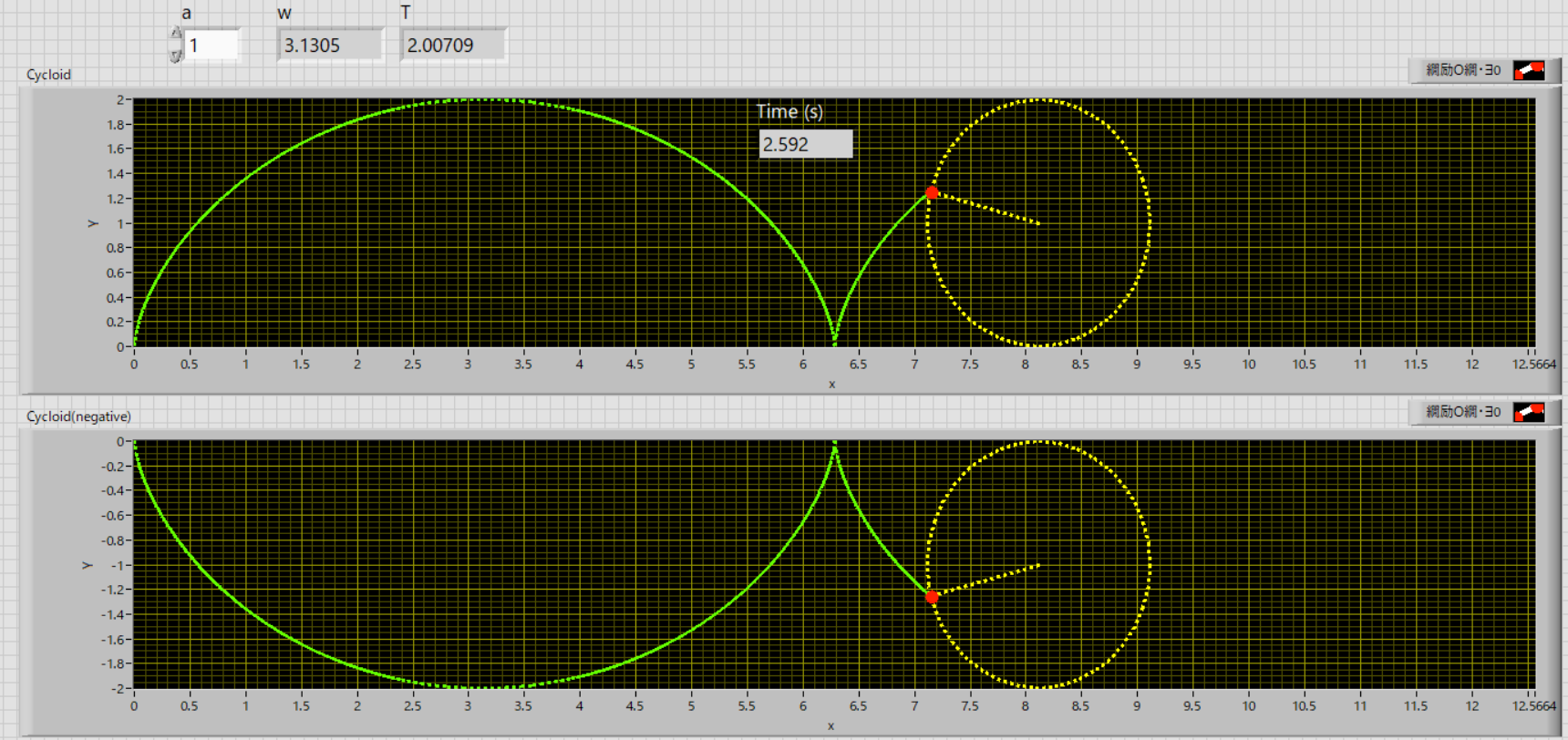
動画も作りましたので,ここ,からどうぞ.


